Showing posts with label interview. Show all posts

Saturday, March 9, 2013

Q&A with retired Union player Mike Ingoldsby

by Ryan Fay

I recently caught up with retired men's hockey defenseman Mike Ingoldsby.

The Ontario native, who would have been a junior on this year's team, saw his promising career get derailed and ultimately cut short after suffering multiple concussions in his freshman season. There was lingering hope Ingoldsby would return to action, but the blueliner eventually hung up the skates for good.

Ingoldsby remains enrolled at Union and is heavily involved in another extra-curricular activity, the Union Banner, the first political newsletter in the 218-year history of the school.

In this candid Q&A, Ingoldsby talks about the newsletter and what lies ahead for him. He also reflects on his hockey career, dealing with concussions, and the decision to be removed from the roster.
______________________________________

UNION HOCKEY NEWS (UHN): At this point, how are you doing?

MIKE INGOLDSBY (MI): I am doing really well. As long as I make sure I get enough sleep each night and take care of myself I don't have any issues. I consider myself to be back to 100% now. I still have some lingering issues with my neck but they are progressively getting better.

UHN: How did the Union Banner get formed last year?

MI: The Union Banner was formed by a group of students who wanted to try and improve the political discourse on campus. Part of living in a democracy is the responsibility to be informed. The Union Banner is an attempt to foster more political awareness on campus with the hope of creating a discussion that engages the campus community.

UHN: What inspired you to get involved with the Banner?

MI: I have always been very interested in politics, however, when I was playing hockey I never really had time to explore other interests. As hard as it has been to give up hockey, one of the silver linings of no longer playing has been the free time I now have to do other things. I learned about the Banner last year from Zach Jonas, who is the President of the executive board for the Banner. He asked if I would want to be involved and I jumped at the chance.

UHN: Discuss a bit what your responsibilities are with the Banner?

MI: I am the communications director with the Banner. Currently, I am responsible for the Banner's outreach program on campus, whether it be advertising the Banner with posters on campus, or trying to recruit new writers. I also run our Twitter and Facebook pages, and am responsible for keeping our readers and contributing writers informed through e-mail. If anyone wants to follow the Banner on Twitter, our account is @UnionBanner, or you can check us out on Facebook.

UHN: What are you hoping to do after undergrad?

MI: I am still undecided about what I want to do. I would like to go home to Canada and get involved in politics there, maybe work as a staffer for a Master of Parliament on Parliament Hill. I think it would be a great way to learn the ropes and gain experience. I also plan on going to grad school eventually to get my masters in public policy.

UHN: Moving to hockey - discuss a bit what your recruiting experience was like with Union and what made you decide to come to Schenectady?

MI: I went through a long recruitment process with Union. I first started talking with coach Bennett in my 19 year old year of junior hockey. At the time he was finalizing a commitment with one of my teammates, Jeremy Welsh. By playoffs of that year, [former assistant] coach Ben Barr and [former head] coach Nate Leaman had also came to see me play. During that summer I came down and visited the school with my Dad and I loved the campus right away. It's such a great campus. I liked that it was small, and the small class sizes. 

Another thing was I knew Union was a very good academic school. That was important to me because if I ever got hurt playing, I would have my degree to fall back on. Low and behold, that turned out to be a great decision. Mostly though, Union was a good hockey program, and I wanted to go somewhere where I would have the chance to win. Knowing Welshy already made it a much more comfortable situation as well. The following year I committed early on in the season.

UHN: What other Division I schools expressed interest in you? 

MI: I had talked with a number of schools, but I eventually narrowed it down to Union, Clarkson, Brown and Merrimack.

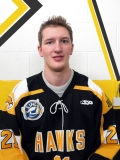
Ingoldsby
UHN: What happened on the play that led to your initial injury freshman year? 

MI: I actually got hit in practice, and I banged my head on the glass. When it happened I felt alright and I didn't realize it was a concussion, but as time went on, I developed headaches and other symptoms.

UHN: You came back for a couple games later in your freshman season - 1/7/11 vs St. Lawrence and 1/8/11 vs Clarkson. You scored your first collegiate point (an assist) in the second contest. But those games were it for the rest of that season. What led to the decision to sit out the rest of that year? 

MI: After getting cleared by the doctor, I came back for those two games against St. Lawrence and Clarkson. On my first shift back on the Friday night, I got blindsided and the guy connected with my head. Afterwards, I knew I didn't feel quite right. After the weekend, I was sent back to the doctor by the team trainers, and the doctor told me I had another concussion. I had very bad headaches and I was having trouble even focusing in class, so the doctors made the decision to send me home. They thought if I went home and got away from campus it might help my recovery. 

However, the headaches continued throughout the year and the doctors wouldn't let me return to school until I was symptom free. It was always the doctors who made the decisions. There was a perception by some people that I decided to sit out the rest of the year. What people don't understand is that it was not my decision. I was still experiencing very bad symptoms, so the doctors wouldn't let me play.

UHN: You were reportedly going to be out for the first half of your sophomore season but you never made it back. What happened there?

MI: There was never a set time table for when I would return. I know it was reported that I would miss the first half of the year, but that was simply because the doctors said I wasn't healthy enough to return to school in the fall. I was still having bad headaches and wasn't even able to read or watch TV for more than a half hour without aggravating my headaches. Finally, my head got better in November of 2011, and then I was cleared to return to school. However, I was never given clearance to return to hockey, just to return to school. At that point I hadn't even worked out in over a year.

UHN: During the last offseason, you were removed from the roster. Whose decision was that and what were the reasons behind it?

MI: The decision was mine. Once I got back to school, I had difficulties handling it. I slowly got used to school again, and built up my brain stamina again. At that point I hadn't played in over a year, and I had spent the worst year of my life mostly at home, basically doing nothing, just trying to recover. When I first got home, I spent almost two months just laying in a dark room, lights bothered me, noise bothered me. As the symptoms dragged on, my focus changed from returning to the team, to simply getting my life back and feeling "normal" again.

When I got to school, I basically had my mind made up. I have had a number of concussions throughout my hockey career, and I decided that, even though I love the game, I didn't want to risk my health to keep playing. I want to be able to function and have a good quality of life in 30 years. You know, you can replace anything else, knees, shoulders, wrist, but when you go through what I did, it's a really scary thing. 

And there is no way to understand it unless you have gone through it. I knew even if I did come back and play, it wouldn't be fun because I would always be worried about getting another concussion. So I sat down with coach Bennett, and I explained that I wasn't going to be coming back to play, and that I was retiring. Coach was very good about it, and I really appreciated that. He completely respected my decision and I can't thank the coaching staff and the training staff for how good they were to me throughout the whole ordeal.

UHN: What are a couple of the things you miss most about playing?

MI: You know, you always hear guys who have played in the NHL and are now retired say this, and it is absolutely true: the thing I miss most is the guys. I miss being around the guys day in and day out. There is nothing better than that camaraderie. I miss the little things, just things like hanging out in the room before and after practice, or getting ready for games, taping sticks, warming up, skating out for introductions and warmups. There is nothing quite like the feeling of every single guy being in it together, and willing to do whatever it takes for the guy next to them.

UHN: Do you have any interest in getting back into the game down the road in a non-playing capacity (i.e coaching, scouting, broadcasting, etc) ?

MI: I have thought about it. Coach Bennett offered to let me get involved with the team, and I am sure down the road I will come back to the game and want to coach because I still love the game. But right now, I am really just enjoying having a chance to explore my other interests. Over the last six or eight years, hockey was everything. I was training and skating in the summers, and then when the season came around I had no free time at all. It has been nice to get away form the game for a bit. 

Right now I am enjoying getting involved on campus with things like the Banner. I am interning in a U.S Senator's office, and in the spring I am going to Washington, D.C as part of the school's "term in D.C" intern program. Of course, I am still the team's biggest fan, and I am enjoying going to all the games and cheering them on.

Tuesday, February 19, 2013

Recruit Lichtenwald on tear in SJHL (w/ Q&A)

by Ryan Fay

Men's hockey recruit Eli Lichtenwald has been surging since being re-acquired by the Nipawin Hawks of the Saskatchewan Junior Hockey League (SJHL) in late December.

Lichtenwald, who is set to join the Dutchmen this fall, has 21 points (8 goals, 13 assists) in 16 games since the trade with Omaha of the U.S Hockey League.  

Lichtenwald had spent the past season-plus with Omaha, where he collected 29 points (8 g, 21 a) in 70 games.

The forward previously played for Nipawin during the 2010-2011 campaign and accumulated 45 points (21 g, 24 a) in 56 contests en route to league rookie of the year honors.

For some insights on Lichtenwald, I checked in with Doug Johnson, head coach and general manager of the Hawks. Johnson, who also coached Lichtenwald in his first go-around in Nipawin, describes what kind of player he is, his upside in Division I, and more.


Lichtenwald (Nipawin)
UNION HOCKEY NEWS (UHN): What kind of player is Lichtenwald?

DOUG JOHNSON (DJ): Eli will be an all around player. His most intriguing attribute is his size (6'6"/216). He takes up a lot of space which helps him defensively but also offensively using his reach to protect pucks. For a big player he skates incredibly well and has an extremely good skill set. The biggest thing with Eli is that he has a lot of room to improve. He is a late bloomer. He was an average midget player that blossomed his first year of junior and will only get better in the future. What Union fans see from Eli as a freshman won't even be comparable to what they see from him as a senior.

UHN: What type of upside does he have at the Division I level -- a depth guy? a regular? an impact player? 

DJ: I firmly believe Eli has the ability to be a very good regular with the possibility to be an impact player if he keeps developing like I believe he will. The level of his success will be very dependent on how he adjusts to the speed of college hockey and how his skating improves as he moves forward. He is a very good skater for 6'6, but still has room for improvement. Knowing Eli, he will make the necessary strides.

UHN: How would you gauge his readiness for Division I college hockey? 

DJ: Like most players, Eli will probably have his bumps along the way during his freshman season. But I believe he will be able to step in and contribute right away in whatever role the coaching staff wants from him. His willingness to do whatever it is needed from the team and his ability to play all those roles will help him make the transition to the college hockey.

UHN: His numbers in Nipawin are a lot better than what he did in Omaha. What do you attribute that to? Is the USHL that much tougher?


DJ: From my time coaching in the USHL, I do know that the USHL is a stronger league than the SJHL. I don't think this is the main reason his numbers have improved as dramatically as they have though. Does the competition make some difference? Absolutely. But I believe that the role we have him playing in and the opportunity to showcase his skill are the biggest factors in his increased production. He showed his first year of junior hockey that he has the skill and ability to be a top six forward. A player doesn't forget how to score or how to make plays. They just need to have the opportunity to showcase their skills and the confidence from their coaches to allow them to make plays.

Wednesday, February 13, 2013

Q&A with Brown associate head coach Mark White

by Ryan Fay

Fresh off a 1-0 shutout of #9/10 Yale, surging Brown (9-9-5, 5-6-5) comes in for a pivotal stretch run game Saturday night at Messa Rink. The Bears enter the weekend just one point behind Union (13-10-5, 6-6-4) in the league standings and both teams are fighting for a first-round bye.

In advance of the game, I chatted with Brown associate head coach Mark White. He discussed what he saw from Yale last night, breakout players like Matt Lorito and Anthony Borelli, his impressions of Union, and more.

UNION HOCKEY NEWS (UHN): Yale comes here on Friday. What were your impressions of them last night?

MARK WHITE (MW): They transition really well. They're going to be poised for a playoff run. It's a typical Yale team. They have a couple elite level players and they're a fast team. Yale has a defense that can move the puck. There were some questions about their goaltending with Jeff Malcolm out but I thought Nick Maricic (31 saves) looked pretty solid.

UHN: What can you say about the way Anthony Borelli has been playing in goal for you? His numbers (1.42 goals against average, .951 save percentage) rank him as one of the best in the country since he took over for Marco DeFilippo in early December.
Borelli (Brown)

MW: Anthony has taken the opportunity he was given and ran with it. He's been fantastic and very competitive in net for us. You look for a senior or two every year to step up and he's been that guy for us. You're usually only as good as your senior class. We've had a couple guys step up and he's been one of them. We had Mike Clemente getting the bulk of the starts the past couple years, but Anthony has proven he can play at a very high level.

UHN: Matt Lorito is breaking out in his sophomore season. His 14 goals leads the team and rank second among ECAC players. What's spurring his improvement?

MW: Matt missed the first seven or eight games with a wrist injury last year. To miss those games as a freshman made it tough to get off to a good start. He's a dynamic skater, has a knack for scoring, and he uses his speed to get into scoring situations. He played with senior Jack McClellan (15 goals) last year and that may have taken the load off him a bit. This year he's taken it more on himself to do some of that scoring. We're not a team that scores a lot, but he's doing the bulk of our scoring.

UHN: Your club is 3-0-1 over the past four games. What's clicking?

MW: Our goaltending is very strong. We play a strong defensive game and we don't give up a lot of "grade A" chances and second chances off rebounds. Beyond that, there's a belief in the locker room that we can win hockey games any way, any how. We're blocking a lot of shots and doing the little things that lead to wins. Guys are playing with a lot of grit right now. It's a small little stretch of wins, but we need to keep that going. It's crazy how tight the standings are.

UHN: Brown is riding a three game unbeaten streak against Union (2-0-1). Most other league teams haven't been as successful against them lately. Why do your guys match up so well against them?

MW: We've gotten good goaltending against them be it this year or last year. Union is usually ranked pretty high when we play them and the guys get up to play a nationally ranked opponent. Union has proven that they're an elite level program the past couple years. It's no different than any other ranked team that we play. We want to play everyone hard.

UHN: What were your impressions of Union when your guys skated to a 3-3 tie with them in December?

MW: They're a good team. Union has what you need in the special teams department. That's something that hurt us earlier in the year, but we have corrected that a bit. 33% of the game is played on special teams and Union excels in that area. They're not a team that beats themselves a whole lot. They have an identity, they stick with that identity, and they're disciplined in how they play.

UHN: Other than special teams, what are a couple other keys to the game from your end?

MW: We need to find a way to get traffic and pucks to the net. We pride ourselves on eliminating as many odd man rushes as possible and that tends to eliminate a lot of "grade A" chances for our opponent. If we work through the middle of the ice, we'll have a good chance to compete.

Thursday, February 7, 2013

AUDIO: Bennett previews weekend

by Ryan Fay

Before Thursday's practice, I chatted with head coach Rick Bennett about this weekend's games at Clarkson and St. Lawrence.

You can listen via the embedded player below. If you can't see it, click here.


IN CASE YOU MISSED IT...

Q&A with Clarkson broadcaster Bob Ahlfeld (Wednesday)
Union defenseman Mat Bodie nears school record (Thursday)

Wednesday, February 6, 2013

Q&A with Clarkson hockey broadcaster Bob Ahlfeld

by Ryan Fay

With Union set for a trip to Clarkson on Friday, I chatted with Bob Ahlfeld, the voice of Golden Knights hockey.

Ahlfeld talks about Clarkson's recent turnaround as well as key players like Joe Zarbo, Pat Megannety, and T.J Moor. The play-by-play man also discusses Friday's game and how the top four in the ECAC may end up.

UNION HOCKEY NEWS (UHN): After a 5 game losing streak, Clarkson is 2-1-2 in their past 5. What's clicking lately that wasn't earlier?

BOB AHLFELD (BA): I realize it sounds simple but getting pucks to the net, and then finishing when they’re there has made a big difference. For example, in losses to Niagara and Mercyhurst, Clarkson got 40+ shots in each game but only scored one goal combined. 
It began in a 5-1 win at Harvard on January 25th when they got 20 shots in the first period on the Crimson. Not all of them were "grade A" chances but that mindset has helped. There is a bit more of a hunger around the goal and some of the goals have come from gritty areas. 

UHN: Joe Zarbo is busting out in his second year - his 12 goals are tied for third in the league. What's behind his improvement?

BA: Joe has really been moving his feet very well of late and has a great set of hands. Playing with his brother, Matt, has been a comfortable situation for him and Adam Pawlick adds some upper class leadership. While it is impressive how he’s put the puck away, one defining play for Joe was setting up James Howden for the game tying goal last Friday against Colgate. I’m sure most of the building, and certainly Colgate, expected him to shoot from the high slot and he waited long enough to get the puck to Howden for what turned out to be a huge point. He has the ability to create, even from a broken play, that few guys have. Plus, many of his goals have come at key times, whether it be to stop the momentum of the opponent or to add to Clarkson’s pressure. His play has made teams take notice and that will hopefully open things up for others.

UHN: Pat Megannety is tied for second on the team with 16 points despite being a freshman. What have you seen out of him this year? 


Ahlfeld (Clarkson)
BA: Pat has been a pleasant surprise on the points side of things. Very telling to me was the confidence the coaching staff showed in him by moving him to center (he had played wing all season long) this past weekend against Colgate and Cornell. He did not look out of place, and he, Simon Bessette and new addition T.J Moor had a lot of energy against the Raiders and Big Red. Some guys in junior come from teams that aren’t as system oriented as college teams, but that wasn’t the case with Pat. He’s made the transition to the college game fairly routine and doesn’t seem fazed at all by the speed or physical nature of college hockey.

UHN: Moor is the current ECAC player of the week after picking up three goals and an assist over the weekend. Overall, he has 7 points (3 g, 4 a) in 9 games this season. He didn't join the team until January, but what have you seen from him?

BA: T.J came in after working on his grades in the fall semester. The way he has moved seemingly seamlessly into the line-up makes you forget that he was not on the ice in the fall at all. He has made an immediate impact and even in the games when he’s not scored he’s created some chances for the team. He has made some very smart decisions with the puck in all three zones and is gaining confidence in every shift.

UHN: Clarkson is the most penalized team in the ECAC and their PK ranks near the bottom of the league. Union's PP is one of the best in the country. How much of a concern is that going into the game?


BA: Each of those can be a bit misleading. If you look at the top 10 in PIMs, there are some very good teams in there. Quinnipiac and North Dakota are just a shade behind Clarkson in penalty minutes. Denver and Duluth are ahead and those are all top 15 teams. Now with Quinnipiac they are at a 90 percent penalty kill and that stat is even more impressive when you see the number of penalties they take. 

I also believe there are certain penalties that can embolden a team depending on how they are taken. For example, aggressive penalties that make the opponents not as comfortable with the puck or a penalty that blunts a great scoring chance by the other team. Those kind are easier to kill in my opinion than ones that take you away from scoring chances or happen because of inattention to detail. 

As far as Friday’s game, I believe that Clarkson’s ability or inability to stop Union’s power play will be huge. Good teams like Union make you draw penalties. Withstanding the pressure of penalties and using the momentum of a great penalty kill will make a big impact for Clarkson.

UHN: How do you see the game unfolding?

BA: I’m forever wrong about how games will unfold. In fact, I think the last one I was right about was the Boston College vs. Yale NCAA game that I joked was going to be first team to 10 goals (and BC won 9-7). And in my mind I thought a good start against Cornell and getting a lead on Saturday was key and the Big Red scored 58 seconds in. Look how that one turned out -- Clarkson won, 6-3. 


I believe Union to be one of the strongest teams in the country and it will take a strong effort by Clarkson to overcome them. One thing going for Clarkson is that there are so many new players who don’t have a history of frustration against the Dutchmen. I have to believe the team and staff are excited to see how the teams match up.

UHN: How do you see the ECAC top four unfolding after Quinnipiac?


BA: Two things are sure, first and last. Quinnipiac has first and Harvard will most likely be the 12th seed. The rest is such a jumble that after Friday’s games we could figure on three teams to be solidly in for a bye, then if those same teams lose on Saturday they could be facing a home game in the first round.

Having not seen Union or RPI yet in person, I’d have to figure that both will be pushing for home ice and a bye (especially with the way RPI is coming on). St. Lawrence has gotten hot, and Dartmouth is dangerous especially at home. One figures with 16 points left, whichever teams are able to get 10 or more of them will be in a good position. Given their experience from last year, you would think Union to be in the top four when it’s all said and done, along with Yale since they are three points clear of third. After that, man, that last spot could come down to the 7th tiebreaker.

Thursday, January 31, 2013

Dutchmen Meet the Media

by Ryan Fay

The 18th-ranked Union Dutchmen host the 16th-ranked Dartmouth Big Green tomorrow at 7:30 pm on the NBC Sports Network.

Before Thursday's practice, defenseman Mat Bodie, head coach Rick Bennett, goaltender Troy Grosenick, and forward Daniel Carr met with the local media. To see what they had to say about the game (and more), watch the videos below.

If you can't see the embedded players, click here to watch.


Q&A with Dartmouth associate head coach Dave Peters

by Ryan Fay

#18 Union (6-4-3, 13-8-4) returns to action tomorrow night at 7:30 pm when #16 Dartmouth (7-5-1, 11-7-2) comes to Messa Rink for a nationally televised game on the NBC Sports Network.

The two teams enter tomorrow's game tied for third place in the ECAC with 15 points apiece. Union will be looking for their fourth in a row and both teams are aiming to solidify a spot in the top four with eyes on a first round bye in the league playoffs.

To get the other side of the story, I interviewed Dave Peters, the associate men's hockey head coach at Dartmouth. A college hockey veteran with over two decades of coaching experience, he's currently in his 14th season on the Big Green staff.

Peters offers thoughts on the game, what he saw from Union in November, and some of his players who could be factors.

UNION HOCKEY NEWS (UHN): If someone is seeing Dartmouth for the first time tomorrow, what type of team will they see?

DAVE PETERS (DP): We're a big team, we play hard, and try to keep the game simple. We try to get pucks deep, we try to get pucks to the net, and we try to get our forecheck going. We try to play really good tough defense and try to keep the puck out of our zone. We like to transition and get pucks behind the opposition's defense and work it low.

UHN: What were your impressions of Union when you beat them, 3-2, at your place on November 10th?

DP: We were very impressed with their team and have been the past few years. Union has a lot of talent, they're very well coached, and they have an excellent powerplay. Their whole defensive core is good, but the thing that impresses me the most is they have three defensemen who remind me of the "big three" on the Montreal Canadiens from way back (Larry Robinson, Guy LaPointe, Serge Savard). To have a defenseman on the ice at probably all times that can get you out of a jam, move the puck, control the play, and add to the offense is what sets Union apart.

Even though they lost Jeremy Welsh and Kelly Zajac, who were really good players, Union has a good group of forwards. Wayne Simpson, Kyle Bodie, and Daniel Carr have put up great numbers this year. They have a Hobey Baker caliber goaltender in Troy Grosenick. It's talent and depth at all positions and that's what is really impressive.

UHN: Your leading scorer, Tyler Sikura, was good as a freshman last year (25 pts, 33 games) but looks to be even better this year (25 pts, 20 games). What makes him dangerous?

Sikura (Dartmouth)
DP: He's a player you can play in all situations. He's killing penalties, he's on the powerplay, and he plays a regular shift. He's a very good offensive player and has an excellent hockey sense. Sometimes you have a playmaker who isn't a goal scorer, but he can also score. He has a tremendous release on his shot and his skating and strength have both improved over last year. That's given him a little more confidence.

UHN: How important is it to have a healthy Dustin Walsh (7 g, 6 a) back in the lineup?

Walsh, a senior, was a sixth round pick of the Montreal Canadiens in 2009 and has battled injuries throughout his Dartmouth career. He recently missed three games, but he returned last weekend and had two goals an assist.

DP: It's really important for us because he's such a talented player. What it does is give us another forward who can score goals and make plays. It takes pressure off Sikura, Matt Lindblad (9 g, 14 a), and Eric Robinson (team-leading 10 goals), who have led our team all year. To add Walsh to that group is another player who can help us offensively.

UHN: After losing a couple senior goaltenders last year (James Melo, Jody O'Neill), junior Cab Morris has stepped up and has a 1.99 goals against average and a .922 save percentage in 12 games. What can you say about his play?

DP: Morris has been very good and consistent. He has given us a chance to win almost every night out and has a tremendous work ethic. He's very prepared on and off the ice and he practices hard.

UHN: Freshman Charles Grant has also seen a healthy amount of time in goal (8 games) and has quickly posted solid numbers (2.61 GAA, .908 save %). How much of a luxury is it when you have two goaltenders  you feel comfortable starting?

DP: It's been good. With Melo and O'Neill playing so much throughout their careers, goaltending was a bit of an unknown for us going into the year. Grant has also done a very good job and has given us a chance to win when he has played. We feel like we have confidence in both goaltenders. We have a third goaltender, James Kruger, who hasn't had an opportunity to play. But we're high on him and feel like he's right there as well.

UHN: Are all your guys healthy going into the game?

DP: We lost Brandon McNally (6 g, 5 a) in the Brown game (January 18th). He's not going to be available for us this weekend.

UHN: How would you say your club has been playing leading up to tomorrow's game?

DP: We've been a little inconsistent. But we like our team and feel we've been playing solid hockey.

UHN: Your squad is the least penalized team in the ECAC, so how important is that considering Union's powerplay is best in the country?

DP: It's really important. You have to stay out of the box, play with discipline, and limit the powerplay opportunities. We've done a good job of that this year and hope to continue that.

UHN: What are a couple other keys to the game from your end?

DP: We have to play with confidence. We're playing in an opposing building, so we have to keep the game simple, play our system, and be good defensively. We have to get pucks behind their defense and play the game in their end. We need to get pucks and traffic to the net. That's what we call playing the right way, and if we do that, we should have a chance.

Can't make it to the game? Find your local NBC Sports Network channel.

Wednesday, January 30, 2013

Q&A with Tri-City Storm head coach / GM Josh Hauge

by Ryan Fay

Josh Hauge, the head coach and general manager of the Tri-City Storm of the United States Hockey League, has an interesting connection to the Union men's hockey team.

Not only is he coaching a player set to come next season, Michael Vecchione, he's also coaching a player who recently left the program, Trevor Mingoia.

Vecchione, who had a power play goal and two assists in last night's 5-2 win over Sioux City, has 14 goals and 23 assists in 40 games this season.

Since departing Union, Mingoia has two goals and 20 assists in 29 contests, including an assist on Vecchione's goal last night.

On Wednesday, I conducted a phone interview with Hauge and asked him about both players and more.

UNION HOCKEY NEWS (UHN): For those who may not know, how good is the talent level in the USHL?

JOSH HAUGE (JH): It's the best 16-to-20 year olds in the country who aren't in college hockey. It's the top tier in United States junior hockey and a great league.

UHN: What are the benefits of playing in the USHL prior to college hockey?

JH: A player gets to be bigger, stronger, and faster. A player can really develop and mature. He finds out what it takes to manage his time and live away from home.

UHN: What kind of player has Vecchione been for you the past couple years?

Hauge (Tri-City Storm)
JH: The thing the fans notice is just how good of a skater he is. He's extremely fast, plays at a fast pace, and has a natural ability to score goals.

UHN: Vecchione has eight more points in nine fewer games than he did last year. What's behind the improvement?

JH: He's really developed as a player. He has a confidence now that he can score at this level. Statistically, he's improved a lot but his overall game has also improved by a lot... areas like his defensive play, his ability to block shots, play tough, and do the little things.

UHN: What's the biggest thing Vecchione will need to improve on at the college level?

JH: He needs to get that confidence right away that he can score at the collegiate level. It's a big adjustment for any player. But if he goes in there and plays confident, he'll be able to make a difference right away.

UHN: When Mingoia left Union, how did he end up in Tri-City?

JH: There were rumors that he was leaving school and we called some different people. I called the coaching staff at Union and they said they were talking but hadn't heard anything officially. The Union coaching staff was great through the whole process in helping us get Mingoia here. Even though [Union] didn't work out for him, I respect the way they took care of their player.

UHN: What have been your impressions of Mingoia since he joined your club?

JH: He's a great skater and he plays fast. I think he's learning to play a little tougher and a little harder than he did in college hockey. He'll be more successful the second time wherever he ends up next year.

Sunday, January 27, 2013

Same old story for RPI in 3-2 loss to Union (plus 3 postgame videos)

For postgame videos, click here or scroll down. There's three - RPI coach Seth Appert, Union coach Rick Bennett, and Union players Josh Jooris/Matt Wilkins/Troy Grosenick.

==========

by Ryan Fay

ALBANY -- There are some things that never seem to change.

Take the RPI-Union series. After losing to their route 7 rivals, 3-2, in Saturday's inaugural Mayor's Cup game, RPI's loss was just more of the same.

Earlier this week, I asked RPI head coach Seth Appert about Union's success against his team. One the things he said was "we've taken some ill-advised penalties against them and they have an absolutely lethal power play."

Saturday's loss, RPI's eighth in a row against 19th-ranked Union, was a continuation of that. RPI's Nick Bailen, a senior, took what most would call an "ill-advised" penalty when he went off for interference with 97 seconds left in regulation of a tie game. After the game, Appert offered "no comment" on the penalty.

Wilkins (Union Athletics)
At the time of the penalty, RPI had recently tied the game at two off the stick of Mark McGowan, so the last thing the Engineers wanted to do was give the country's best powerplay (27.1%) a chance to win the game.

Matt Wilkins, who turned 22 on Saturday, proved why Union's powerplay is "absolutely lethal" when the freshman forward scored the game-winning goal on the powerplay with 37 seconds left in the game. 

"I was driving the net, I saw Jooris go wide, and their defensemen was sort of flat footed," Wilkins said of the game-winning play. "I drove the net and Jooris made a great pass."

Said Appert of the goal, "at the end of the day, [Wilkins] made a play. We had two guys that didn't execute very well. It was a play that should have been pretty easily defended. We had two guys that made mental mistakes in big moments and they have to grow up from that."

It was the second goal of the night for the Union powerplay, which finished 2-for-4. After Guy Leboeuf was called for cross checking just two minutes into the game, Daniel Ciampini opened the scoring by knocking in a rebound at 3:34.

"It always seems like we take a penalty early and get scored against them, and we did,” Appert said after the game. “It played out, pretty much, how you anticipate [it]."

Earlier this week, Appert also pointed out Union's penalty kill as another reason why Union has had its run of success against his club. On Saturday night, the Dutchmen killed off all five RPI powerplay opportunities, including two in the third period. The Engineers, who outshot Union 38-20, had 15 of their shots on the powerplay including 11 in the first.

Troy Grosenick stopped all 15 powerplay shots and 36 of the 38 overall. When I spoke with him on Tuesday, Appert credited "very good" goaltending as yet another factor behind Union's recent edge in the series.

Grosenick was the biggest reason Saturday's game came down to the third period. For a good portion of the night, RPI was outskating the Dutchmen. The junior netminder kept Union in the game with several spectacular saves, including a couple on Ryan Haggerty, RPI's top goal scorer. The sophomore, who has ten goals this season, did beat Grosenick on one of his five shots, a goal that tied the game at one only 16 seconds into the middle period.

Union head coach Rick Bennett graded Grosenick's performance as "exceptional" and added Grosenick "kind of bailed us out when we needed him to."

Bennett also came away impressed with RPI (8-11-5, 3-6-3).

"That's a good hockey club," he said of RPI, which won the faceoff battle, 37-25. "They've been making strides this season just like they did last year. Whoever faces them in the playoffs better buckle up."

Greg Coburn scored Union's other goal, a long-range rocket early in the third period that momentarily gave the Dutchmen a 2-1 lead.

Union (13-8-4, 6-4-3) resumes play on Friday night at Messa Rink against #12/13 Dartmouth (11-7-2, 7-5-1). The game, a 7:30 pm faceoff, will be nationally televised on NBC Sports Network.

POSTGAME VIDEOS


Rensselaer (8-11-5 (3-6-3 ECACH)) vs. Union (13-8-4 (6-4-3 ECACH))
Date: Jan 26, 2013 Location: Albany, NY Arena: Times Union Center
Attendance:5959 Start time:7:30 pm End time:9:35 pm Total time:2:05 
Goals by Period 1st 2nd 3rd Total 
Rensselaer  
Union  
Scoring Summary
Prd Time Team Type Scored by Assists Visitor on ice Home on ice 
1. 1st 03:34 UNION  PP Ciampini, Daniel/8 Coburn, Greg/12 22,24,21,11 17,20,12,21,14 
            Simpson, Wayne     
2. 2nd 00:16 RPI_MHKY EVEN Ryan Haggerty/10 CJ Lee/5 29,15,39,22,10 9,14,18,20,19 
            Nick Bailen/11     
3. 3rd 01:51 UNION  EVEN Coburn, Greg/8 Simpson, Wayne/15 23,24,3,17,19 20,21,14,12,17 
            Bodie, Kyle/12     
4. 3rd 15:36 RPI_MHKY EVEN Mark McGowan/5 CJ Lee/6 21,22,28,15,3 22,16,20,15,7 
5. 3rd 19:23 UNION  PP Wilkins, Matt/3 Jooris, Josh/10 21,22,10,11 19,7,22,18,9 
            Bodie, Mat/13   

Thursday, January 24, 2013

Q&A with RPI men's hockey head coach Seth Appert

by Ryan Fay

Union and RPI are set to renew their heated rivalry with Saturday's 7:30 pm "Mayor's Cup" game at the Times Union Center.

It will be the third meeting between the schools this season and the first since Union's 7-3 win on November 3rd. Union has a seven game winning streak against their Route 7 rivals, but RPI still has the all-time series lead in Division I play at 29-26-9. RPI last beat Union, 4-3 in overtime, on November 13th 2010.

On Tuesday afternoon, I conducted a phone interview with RPI men's hockey head coach Seth Appert. The coach dissects the recent improvement of his team, Union's success against RPI, a few of his players who could loom large in Saturday's game, and more.

UNION HOCKEY NEWS (UHN): If someone hasn't seen your team play yet this season, what style of team will they see on Saturday?

SETH APPERT (SA): What we try to be is a hard, fast, disciplined team. We've been turning into a very good defensive team. I think we're doing that not by being passive and sitting back, but by being aggressive, forechecking well, and being physical. We're at our best when we're playing fast, hard, and physical -- taking time and space away from our opponents when we don't have the puck so we can get it back.

UHN: Your team has won or tied five of its past six league games, including handing Quinnipiac its only non-win in league play this year (a 1-1 tie on Jan. 11). You also split a non-league series at now #16 St. Cloud State in late December. What's fueling the improvement?

SA: We're playing pretty good hockey these past two months in league and out of league. Even in the games we have lost, we've played very well either for large portions or all of the game. Day in and day out, and game in and game out, we've been real committed to playing the right way and doing little things that give us a chance to win hockey games.

UHN: After the first game with Union earlier this season, you thought your team showed a lack of maturity. Has more maturity been another factor in the recent improvement?

Appert (RPI Athletics)
SA: We're growing up slowly. We still show some moments of immaturity as evidenced by being a little sloppy in the first period against Princeton but we had a dominant 40 minutes after that. Our captain, C.J Lee, is doing a fantastic job of getting the guys on the same page. Lee and I are in sync in terms of how we see things and what we value. That consistency is starting to take hold a little bit. We were immature in that Union series and we continued that immaturity the next weekend at Harvard and Dartmouth, but since then, we've been a real good hockey team. We've done a lot of things the right way. We're not perfect, and we still have things to improve upon, but we are slowly turning into a very physical, disciplined, tough hockey team.

UHN: Union has been successful against a lot of teams in the past few years, including yours. What's made them especially dangerous in the games against your team?

SA: They've kept their composure better. We've taken some ill-advised penalties against them and they have an absolutely lethal power play. They have very good combined special teams (power play and penalty kill) and they receive very good goaltending. You combine those things together and they've found their way to quite a bit of success against us these past few seasons.

UHN: Union has had its share of struggles in the past couple months. Is it fair to say you could be getting them at the right time?

SA: I'm more concerned with our team. It looks like Union played pretty well last weekend, having a lead on Cornell late in the game and beating a pretty good Colgate team the next night. Union has a very good team and I still believe they're a top 15 team in the country. Every team goes through ups and downs at some point of the season. In terms of getting them at the right time, the schedule is what it is, and all you worry about is the next day of practice and the next game in front of you.

UHN: What can you say about your freshman goaltender, Jason Kasdorf? A sixth round pick of Winnipeg in the 2011 NHL draft, he's played in nine games and has a 4-1-2 record.

SA: He's given us a good swagger and a good belief in ourselves. We have three very good goalies, but he's been able to separate a bit, and the numbers bear that out. His winning percentage (.714) and save percentage (.943) are higher [than our other goaltenders]. All goalies at this level have very good athleticism and ability to make big saves. What he's done a good job of in his freshman year is limiting the number of soft rebounds and soft goals. Bad rebounds lead to goals and goals deflate a team. He's done a good job at making big saves when necessary and taking care of the little details that add up to big things.

UHN: Milos Bubela, a native of Slovakia, is tied for second on your team in goals (seven) despite being a freshman. What has stood out about him?

SA: We were pretty excited about him with his international background (he played in the World Junior Championships last year). It's been a big transition -- he's coming to college hockey, he's coming to college, he's learning another language, and a different style of play compared to what experienced in Europe. What Bubela has done a good job of is quickly buying into the more physical play of North American hockey. He's had a willingness to compete for loose pucks, to be physical, to finish checks, and to win battles. When you do those things, you have the puck more. When Bubela has the puck, like most good offensive players, he's very dangerous and can do a lot of great things. Where some offensive players struggle is that they don't work hard enough to get the puck. Bubela has done a good job in the past few months of understanding that and getting the puck more through his efforts. Because of that, he's been rewarded with more offensive opportunities.

UHN: Matt Neal, Ryan Haggerty, and Jacob Laliberte, have (at times) formed what's known as your "N-H-L" line. They all came to your program with big expectations, but now in year two, they're your top three scorers. What can you say about their development?

SA: They're all making steps in their sophomore year. They all have a lot of growth left to go - not only the rest of this season, but into the future. They've shown a good willingness to buy into the coaching and a desire to get better. A big jump from your freshman to sophomore year is how hard you train in the summer because now you know what it takes to be a Division I hockey player. All three had good summers in the weight room and showed a high level of commitment and discipline towards their offseason training. They have a little more maturity and understanding of their abilities.

UHN: How do you see the game going on Saturday night?

SA: As a coach, you never predict those things. All you do is prepare your team the way it needs to be prepared to give your young men a chance to go ahead and have success. We're really focused on having good practices and getting guys back into the swing of things academically with school starting up this week. We're just making sure we continue to take steps forward as a team like we have the past two months. We'll put the guys out there Saturday night and they'll dictate it from there.

Special thanks to Kevin Beattie and to Coach Appert.